About
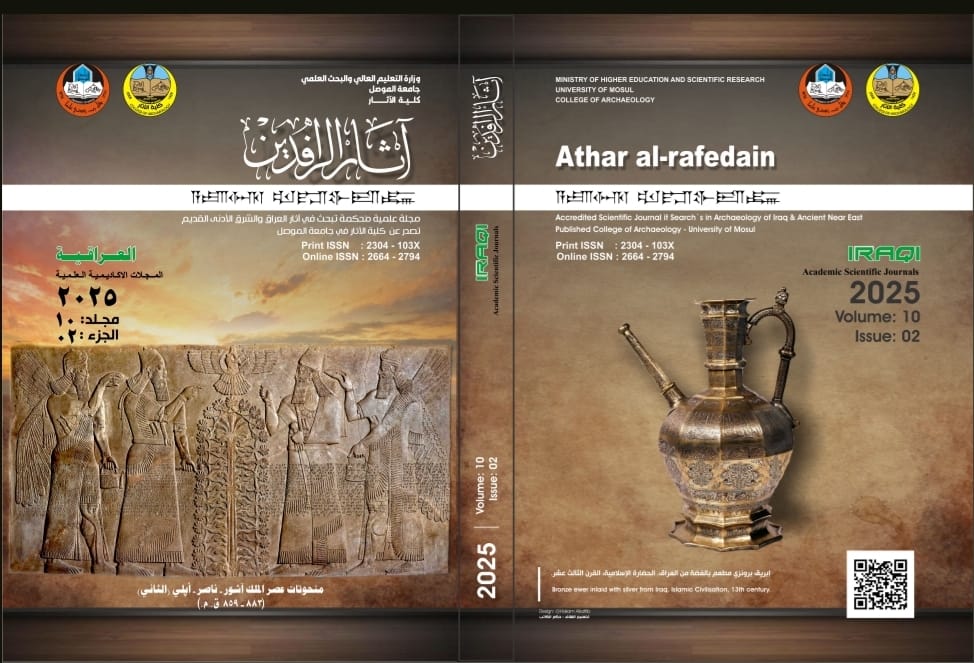
- ISSN: 2304-103X (Print) ISSN: 2664-2794 (online)
- Editor:Professor Dr. Zainab Bahrani ,
Columbia University-Department of Art History and Archaeology
- Editorial Board: https://ojs.uomosul.edu.iq/index.php/athar/index
- E-mail: [email protected]
- Frequency: 2 issues per year
The fees for publishing a research in Athar Al-Rafedain journal are (115,000) One Hundred and Fifteen Thousand Iraqi dinars IQD. Athar al-rafedain journal does not receive any financial support from governmental or non-governmental organizations, and it depends on self-funding.
___________________________________________________________________________________________________
Athar al-rafedain (AARJ) is a signatory to the Sustainable Development Goals (SDG) Publishers Compact. AARJ supports the following U.N. Sustainable Development Goals (SDG) :
The Athar Al-rafedain Journal (AARJ) is proud to be a signatory to the United Nations SDG Publishers Compact, reaffirming its dedication to advancing the principles of sustainable development through academic publishing. As part of this global initiative, the journal actively supports and promotes the following Sustainable Development Goals (SDG):
1. Quality Education (SDG 4)
AARJ is firmly committed to enhancing the quality of education by publishing high-standard, peer-reviewed academic research in the fields of archaeology, history, and heritage studies. The journal aims to provide a reliable scholarly platform that enriches the knowledge and skills of both researchers and professionals.
2. Decent Work and Economic Growth (SDG 8)
Through its sustainable publishing operations, AARJ contributes to promoting decent work and economic growth. The journal’s economic model—based on fair publication revenues—supports the continuity of academic activities and the broader goals of sustainable development.
3. Sustainable Cities and Communities (SDG 11)
AARJ encourages research that explores the relationship between heritage, archaeology, and modern society, particularly studies that highlight the preservation of cultural identity and the promotion of environmentally healthy communities.
4. Partnerships for the Goals (SDG 17)
The journal seeks to foster collaboration among scholars, universities, and research institutions worldwide. By building partnerships in the fields of archaeology and cultural heritage, AARJ aligns with Goal 17 of the SDGs, promoting cooperation as a foundation for sustainable progress.
Current Issue
Vol. 2 No. 11 (2026): Volume 11 Issue 2

Contents
Article
The The status of the Divine Minister and His Duties in Light of the Literary Texts from the Land of Mesopotamia
Nabeel Sheet
This research focuses on studying a category of gods that the inhabitants of Mesopotamia believed acted as ministers to higher-ranking deities. The study highlights the qualifications required for...
DOI: 10.33899/aarj.v2i11.53742
The The Pottery Forms of Tell Abu-Qasim within the Context of Hamrin Region, Iraq
حسن حميدي, ياسمين الاسدي
Abstract This article presents a typological study of 38 ceramic vessels from Tell Abu Qasim within the context of the Hamrin region excavations during the rescue of the archaeological sites...
DOI: 10.33899/aarj.v2i11.63503
Unpublished Unpublished Prayers from the Temple of Nabû-šaḫarê in Babylon
Basima Abd, Angham Salim Al-Dulaimi
Prayer in everyday language: It is simply a ritual discourse that conveys an individual's concerns, that is, human requests, to the superhuman through words. In this sense, prayer is a kind of...
DOI: 10.33899/aarj.v2i11.60531
Aramaic Epigraphs on Clay Tablets of the Neo- Babylonian Period
بهاء الجبوري, Sajjad Abd Al-Saheb
In this article we study four Neo- Babylonian clay tablets from Babylon that contain Aramaic epigraphs. Deriving from the same archival context, these tablets bring to life the social of...
DOI: 10.33899/aarj.v2i11.60389
Rock Rock Art as a Source of Knowledge For Ancient Maghreb
Mohammed Mahfouz, Hussein Youssef
Abstract : The human sense of beauty is innate, and humans have expressed it in a way consistent with their natural instincts—a fact confirmed by anthropologists...
DOI: 10.33899/aarj.v2i11.63314
the Unpublished Jewelry from Haditha Dam Basin Rescue Project sites (Tilbis Island , Jidaida, and Jaraa Wall)
Muntaha Mahmood
تُعد الحلي من الأعمال والحرف الفنية التي أبدع الانسان مبدعًا في تقنية صنعها في مراحل مختلفة من حياته، وتعكس الحلي المكتشفة في المواقع ألاثرية مستوى الذوق الجمالي والفني، وكذلك الحالة الاجتماعية...
DOI: 10.33899/aarj.v2i11.55947
Arab Arab-Islamic Architecture The Great Mosque of Idlib (as a Model) An Archaeological and Historical Architectural Study
Khalid Ahmed Al-Yamani, Anas Ahmed
Abstract: This research includes a field study of the Great Mosque in the Syrian city of Idlib, one of its most important historical and religious landmarks. The aim is to shed light on its...
DOI: 10.33899/aarj.v2i11.63321
The The words of domesticated animals in the Akkadian language – a comparative study with the Hebrew and Syriac languages
Narsai Jibrael, Mohammed Muharib
Abstract: This research deals with a comparative linguistic study of the words for domesticated animals in the Akkadian language, comparing them with their equivalents in Hebrew and Syriac,...
DOI: 10.33899/aarj.v2i11.63322
The The Foundation of Assyrian Capital Dur-Sharukin and Karkh Beth Slokh - Kirkuk City According to A Syriac resource from the 6th Century A.D
Mazin Zara
Among the important works of Syriac literature is a unique group whose roots date back centuries, before Christianity. Its content was transmitted through local sources and in local languages,...
DOI: 10.33899/aarj.v2i11.60371
Planning Planning and Architecture of Marfithian Church
عبدالله سهيل الزيدان
The church is considered one of the ancient christian religious buildings that still stand prominently in the ancient city of Mosul, namely in the area of Shahar Souq (or Mansuriya neighborhood)....
DOI: 10.33899/aarj.v2i11.61421
Formation Formation of the regular trilateral verb in the G-stem in Akkadian
Yasmin Abdulaziz, Ameen Abdulnafi
Abstract: This study investigates the formation of the regular trilateral verb in the G-stem in Akkadian, with particular emphasis on the morphological structure of the strong verb. Adopting...
DOI: 10.33899/aarj.v2i11.63324
Seal impressions in Mesopotamia in Prehistoric and Historical Eras
Buroog Falih
Archaeological excavations in Mesopotamia have revealed many flat and cylindrical seal impressions. Seal impressions are as important as the seals themselves, and perhaps even more so, as...
DOI: 10.33899/aarj.v2i11.63327